 |
:: عضو ذهبي ::
تاريخ التسجيل: Jul 2007
الدولة: مصر / 01146801155
المشاركات: 1,022
|
|
نشاط [ سعيد فايد ]
قوة السمعة:
|
|
 11-06-2012, 06:37 PM
المشاركة 65
|
|

بسم الله الرحمن الرحيم
لقد قرأت ما كتب من الأخوه المهندسين مشكورين
حول انتاج الإليكترون
وقد كان لزاماً ان نجد قولاً واحداً ويكون فصل الخطاب
من ثم أضررت للبحث بالمراجع والمنتديات الأجنبيه
وكانت العبارات التاليه هى نتيجة البحث:

Standard glass-tube televisions and your CRT monitor work quite similarly. A glass cathode-ray tube (1), which contains a vacuum, has three electron guns (2) at its narrow end, each containing an anode and cathode assembly. As you may recall from high-school science, the cathodes emit electrons; the anodes draw the electrons away from the cathodes, focusing and accelerating them into electron beams (3). The deflection yoke (4), around the tube base, precisely manipulates the three beams via electromagnetic force, working with the CRT's circuitry to sweep them across the screen in precise, horizontal lines. Where a beam hits the screen, it causes a red, green, or blue (RGB) phosphor dot (5) to glow; the screen's inner surface is coated with these colored phosphors. (The beams, though colorized in the illustration, are actually invisible.)
CRTs come in two main varieties: shadow mask and aperture grill. In shadow-mask models, the RGB phosphors on the inside of the screen are arranged as a staggered pattern of dots (see the inset); in the latter, they're not dots but repeating vertical RGB stripes. In a shadow-mask CRT, when the monitor receives commands from your PC's graphics adapter, the electron guns fire their three beams, in concert, through tiny holes in the shadow mask (6), a metal screen just behind the phosphor-coated display glass. (Aperture-grill monitors, popularly known as Trinitrons or Diamondtrons, work similarly, but vertical wires, not a mask, funnel the beams.) Their channeled beams illuminate a trio of phosphor dots (a triad (7)) lining the inside of the glass. A pixel (8)—the smallest image element you can see—comprises one or more triads; how many depends on the resolution you specify. The lower the resolution, the more triads that are assigned to each pixel.
The electron guns blaze across the screen, row by row, illuminating phosphors in their wake. Varying the beams' intensity strengthens or weakens the glow from a given phosphor dot; by careful manipulation of every one, the triads and pixels, seen by the eye as single units, create the illusion of different-color dots.
Phosphors don't glow for long, though. Once the guns have scanned the whole screen, they repeat the process—typically, 60 to 80 times a second. (This number is what is known as the refresh rate.) To comprehend the staggering scale of the task: A CRT running at 1,280x1,024 at a 75Hz refresh rate illuminates and re-illuminates nearly 100 million pixels per second.
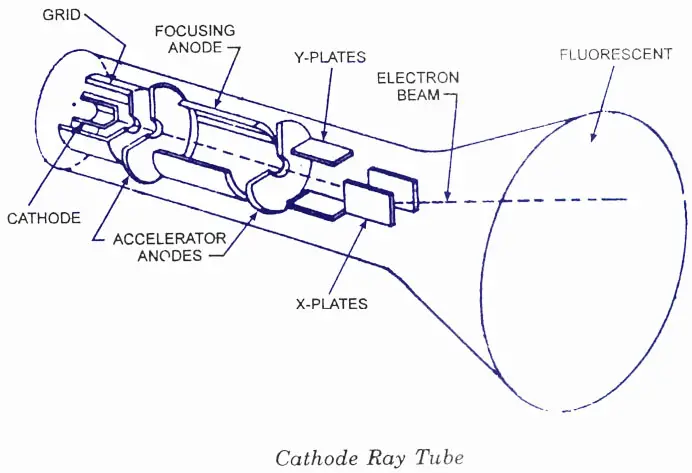
The electron gun assembly consists of an indirectly heated cathode, a control grid surrounding the cathode, a focusing anode and an accelerating anode. The sole function of the electron gun assembly is to provide a focused electron beam which is accelerated towards the phosphor screen. The cathode is a nickel cylinder coated with an oxide coating and emits plenty of electrons, when heated. The emitting surface of the cathode should be as small as possible, theoretically a point. Rate of emission of electrons or say the intensity of electron beam depends on the cathode current, which can be controlled by the control grid |n a manner similar to a conventional vacuum tube. The control grid is a metal cylinder covered at one end but with a small hole in the cover. The grid is kept at negative potential (variable) with respect to cathode and its function is to vary the electron emission and so the brilliancy of the spot on the phosphor screen. The hole in the grid is provided to allow passage for electrons through it and concentrate the beam of electrons along the axis of tube. Electron beam comes out from the control grid through a small hole in it and enters a pre-accelerating anode, which is a hollow cylinder in shape and is at a potential of few hundred volts more positive than the cathode so as to accelerate the electron beam in the electric field. This accelerated beam would be scattered now because of variations in energy and would produce a broad ill-defined spot on the screen. This electron beam is focused on the screen by an electrostatic lens consisting of two more cylindrical anodes called the focusing anode and accelerating anode apart from the pre-accelerating anode. The focusing and accelerating anodes may be open or close at both ends and if covered, holes must be provided in the anode cover for the passage of electrons. The function of these anodes is to concentrate and focus the beam on the screen and also to accelerate the speed of electrons.
|


